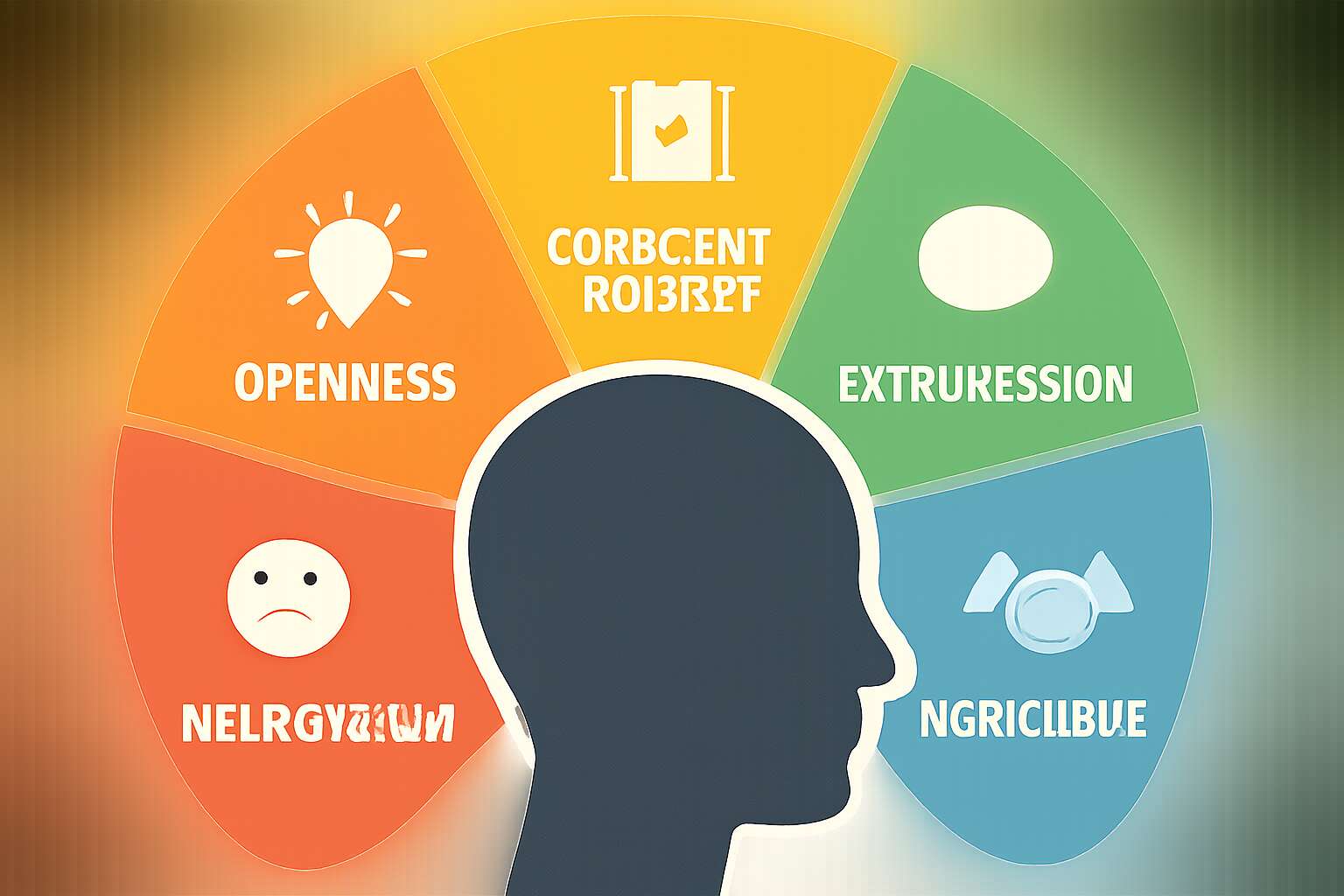
Big Five framework overview
Origins and history of the Big Five
Five traits, one framework, endless implications for people at work. The big five personality model is a trusted lens for how individuals approach tasks, collaborate, and lead—especially in South Africa’s diverse workplaces.
Its origins braid curiosity with rigour: Allport and Odbert’s 1930s adjective harvest, Cattell’s 16-factor groundwork, and McCrae and Costa’s streamlined five-factor model that gained traction in the 1980s. Since then, scholars like Goldberg refined and validated the framework across cultures.
The five traits are:
- Openness to experience
- Conscientiousness
- Extraversion
- Agreeableness
- Neuroticism
In business and education, this framework offers a shared language for talent, teamwork, and transformation, from Cape Town to Johannesburg.
The five dimensions at a glance
Five dimensions shape decision and interaction in South Africa’s diverse workplaces. The big five personality model offers a compact, cross-cultural map for how people approach tasks, collaborate, and lead. As one psychologist notes, “the five-factor model offers a robust map of personality across cultures”—a tool that translates nuance into actionable insight from Cape Town to Johannesburg.
- Openness to experience
- Conscientiousness
- Extraversion
- Agreeableness
- Neuroticism
With a quick glance, these five dimensions span curiosity, reliability, social energy, warmth, and resilience. In business settings, openness invites experimentation; conscientiousness underpins quality; extraversion fuels clear communication; agreeableness smooths collaboration; neuroticism flags stress responses that leaders must nurture or mitigate. This map underpins talent, teamwork, and transformation across SA.
Common methods for assessing the traits
The big five personality model offers a compact, cross-cultural map for understanding how people approach tasks and interact at work. The idea is simple: five broad traits capture core facets that shape behavior. As a psychologist notes, “The five-factor model offers a robust map of personality across cultures,” a map that translates nuance into insight from Cape Town to Jo’burg.
Common methods for assessing the traits include:
- Self-report inventories that ask respondents to rate typical thoughts, feelings, and behaviors
- Informant ratings from colleagues or supervisors who observe day-to-day interactions
- Brief behavioral tasks or situational judgments that reveal decision styles under pressure
- Computerized adaptive testing that tailors questions to prior responses
In practice, these measures map patterns across departments and roles, offering a descriptive lens on teamwork and resilience across South Africa’s diverse workplaces. This big five personality model provides a descriptive lens that helps interpret those patterns without relying on a single score.
Applications in research and practice
Across meta-analyses, the big five personality model explains roughly 40–60% of observed personality variance across cultures, a reliability that travels from Cape Town to Jo’burg—a reliable compass for navigating people dynamics in diverse South African workplaces.
- Talent identification and leadership development
- Team design and cross-cultural collaboration
- Cross-cultural measurement validation and research replication
- Behavioral prediction in selection and performance contexts
In practice, the big five personality model provides a descriptive lens that respects nuance, turning raw data into patterns that spark practical insights for organizations and scholars alike across the country.
Practical applications across fields
Personality assessment in education and careers
Across South Africa, teams that balance the big five personality model traits outperform homogeneous groups on complex projects by up to 20%. “Personality is a compass, not a label,” remarks a South African HR director, reminding leaders that assessments illuminate paths rather than confine people.
In education, the model informs differentiated instruction and targeted mentoring, helping learners engage deeply and avoid drift. In careers, it guides role fit, development planning, and succession strategies, aligning tasks with temperament and motivation.
- Educator planning and student support tuned to motivation and learning pace
- Career guidance that matches graduates to sustainable pathways
- Leadership development that leverages diverse team dynamics
Within South African organisations, this lens—anchored in the big five personality model—supports diverse talent pools, shaping collaborations that respect individual strengths while pursuing shared goals.
Organizational psychology and team dynamics
In organizational psychology, the big five personality model reframes how teams coordinate under pressure. It turns people into living maps of temperament, guiding decisions about roles, communication, and change readiness with clarity rather than guesswork.
When teams are shaped around enduring traits, dynamics shift from friction to flow. Leaders harness complementary patterns to balance risk appetite, problem-solving approaches, and pace, while onboarding and coaching become personalized rather than generic. The result is more resilient collaboration, with faster alignment on high-stakes tasks and smoother adaptation to evolving goals, as if a quiet forecast steers the ship.
- Team composition that pairs complementary strengths
- Conflict resolution tailored to temperament profiles
- Leadership development aligned with motivators and tempo
Clinical and health psychology applications
Clinical practice thrives on nuance. In South Africa, patient engagement rises when care feels tailored—clinicians report patients adhere up to 25% more when treatment fits temperament. The big five personality model provides a practical map, turning temperament into actionable signals about anxiety, impulse, and social style. In health psychology, this lens helps explain why a regimen sticks for some and collides with others, reducing guesswork in assessment and planning.
Across clinical and health settings, the big five personality model informs teams that respect tempo and motivators. This approach shapes how education is delivered, how risk is communicated, and how care plans align with patient values. The result is smoother care journeys and better engagement, even under pressure. Consider these temperament-aware applications:
- Tailored patient education that matches traits like conscientiousness and openness
- Communication strategies aligned with temperament to reduce dropouts
- Risk assessment and treatment pacing that respects individual motivation
Cultural and cross-cultural considerations
Across more than 50 cultures, the big five personality model reveals a sturdy spine of temperament—the trait map endures, with average cross-cultural correlations around 0.70, enough to make a practical map out of temperament without drifting into mysticism.
In South Africa, this universal frame translates into tangible gains: education, healthcare, and leadership development benefit from a shared language of differences and commonalities, even as local languages and social nuance are respected.
Key cultural and cross-cultural considerations include:
- Measurement equivalence across languages and contexts
- Contextual expression of traits shaped by culture and tradition
- Ethical translation and region-specific validity evidence
Detailed trait explanations
Openness to experience
Curiosity is the compass of minds navigating a changing world, and Openness to experience tilts the compass in the big five personality model. Those who score high wander through ideas, savor metaphor and novelty, like explorers charting constellations of possibility. They relish artful nuance, enjoy abstract puzzles, and embrace new experiences—often bringing fresh perspectives to South African classrooms and teams alike.
Within Openness to experience, several facets shape creativity and adaptability:
- Imagination and fantasy
- Aesthetic sensitivity
- Intellectual curiosity
- Originality and nonconformity
- Willingness to entertain unfamiliar ideas
In the big five personality model, this openness signals a readiness to explore, question assumptions, and interface with diverse cultures—qualities that enrich collaboration and problem solving across SA’s dynamic workplaces.
Conscientiousness
In South Africa’s fast-moving teams, deadlines are sacred and plans feel like a shared contract. In the big five personality model, conscientiousness is the steady hand that keeps momentum from unraveling. It blends reliability with self-control and a quiet commitment to doing things properly!
People high in conscientiousness organize, think ahead, and persevere. They spot gaps, manage time with care, and align actions with long-term goals. This trait isn’t about rigidity; it’s about responsible autonomy, steady quality, and consistent contribution—even under pressure!
- Competence and reliability
- Organization and planning
- Achievement striving
- Self-discipline
- Diligence and carefulness
- Deliberation before action
In SA classrooms and workplaces, conscientiousness often anchors trust and cohesive teamwork. When it appears alongside openness and other traits, it smooths collaboration, nurtures dependable routines, and sustains momentum through change.
Extraversion
Extraversion isn’t simply about volume; it’s the social engine behind teamwork in South Africa’s diverse workplaces. A recent HR report puts it plainly: “Energy is contagious in teams.” Teams scoring higher on Extraversion tend to sustain momentum through lively dialogue and quicker problem-solving. In the big five personality model, Extraversion signals comfort with others, energy in social settings, and a readiness to contribute ideas when the moment calls.
- Energetic participation in meetings and discussions
- Comfort with public speaking and presenting ideas
- Warmth and approachability that ease collaboration
- Willingness to lead in group settings
Placed alongside other traits, Extraversion fuels inclusive teamwork, but balance remains essential; environments that value listening and reflection still rely on quieter voices to sharpen decisions.
Agreeableness
In the big five personality model, Agreeableness is the gentle current that smooths collaboration in South Africa’s diverse workplaces. A quiet force, it builds trust and reduces friction. A recent HR survey shows teams high in Agreeableness resolve conflicts up to 25% faster and sustain cooperative momentum across cultures.
- Trust and straightforwardness
- Altruism and concern for others
- Cooperation and compliance
- Modesty and humility
- Tender-mindedness and empathy
Agreeableness blends empathy with pragmatic diplomacy, guiding communication and feedback with warmth. In the big five personality model, this trait underpins inclusive decision-making and constructive dialogue rather than confrontation. In South Africa, it bridges languages and norms while keeping boundaries clear; balance matters!
Neuroticism
Across South Africa’s bustling offices and quiet rural units, Neuroticism threads through how people handle stress, feedback, and change. In the big five personality model, Neuroticism signals emotional reactivity rather than weakness—think watchful caution, sensitivity to threats, and a brisk tempo of worry under pressure. A recent HR survey shows teams with balanced emotional flux resolve conflicts more smoothly and sustain momentum across cultures. That’s a practical edge in leadership!
- Anxiety and worry under pressure
- Angry hostility
- Depression and mood swings
- Self-consciousness and doubt
- Impulsivity and spur-of-the-moment actions
- Vulnerability to stress
In practice, recognizing Neuroticism helps managers tailor feedback, reduce misreads, and balance risk in fast-changing markets. In contexts ranging from finance to hospitality, this trait—when supported by clear processes—can foster empathy, foresight, and resilient collaboration within the big five personality model.
Critiques, limitations, and alternatives
Critiques of reliability and cultural bias
Across the dim corridors of psychometrics, the big five personality model dazzles with apparent precision, yet shadows linger. It explains roughly 40–60% of personality variance, a powerful spine that is not a complete map. In South Africa’s diverse workplaces, reliability frays across languages and contexts, and scores can bend under translation and power dynamics.
Critiques include:
- Reliability shifts with language and administration
- Cultural bias and measurement invariance challenges
- Faking and social desirability in self-reports
- Overemphasis on trait labels over situational dynamics
- Limited predictive utility outside familiar contexts
As a result, many scholars seek alternatives such as HEXACO and domain-specific assessments.
Alternatives offer richer nuance; in practice, teams in SA pair the big five personality model with situational judgments or 360 feedback, or turn to HEXACO and domain-specific measures for context-sensitive insight.
Contextual and situational limitations
Across South Africa’s mosaic of languages and rhythms, the big five personality model promises clarity, yet reliability wobbles when a test crosses borders or tongues. It explains roughly 40–60% of personality variance—a sturdy spine, not a complete atlas.
Cultural bias and measurement invariance challenges keep reappearing in SA: translations, context, and power dynamics can bend scores. Add faking and social desirability in self-reports, and the model loses some of its edge, especially in unfamiliar settings or high-stakes decisions.
Alternatives offer richer nuance; in practice, South African teams pair the big five with situational judgments or 360 feedback, or turn to HEXACO and domain-specific measures.
- HEXACO model
- Domain-specific assessments
- Situational judgment tests
- 360-degree feedback
Differences with alternative models like HEXACO
In South Africa’s diverse workplaces, the big five personality model explains roughly 40–60% of personality variance—a sturdy spine, not a complete atlas. Across borderlands of language and context, translations can tilt scores, and faking or social desirability in self-reports shadow decisions in unfamiliar settings or high-stakes contexts. Reliability wobbles when a test crosses borders or tongues, and cultural bias plus measurement invariance remain persistent hurdles we continually navigate.
Alternatives offer richer nuance and practical balance. For teams seeking depth, consider these approaches:
- HEXACO model (Honesty-Humility adds a critical ethical dimension)
- Domain-specific assessments
- Situational judgment tests
- 360-degree feedback
Interpreting results responsibly
In South Africa’s vibrant workplaces, the big five personality model explains roughly 40–60% of observed behavior—a sturdy spine for decisions, not a crystal ball. Scores shift with language, context, and high-stakes settings, inviting careful interpretation.
Critiques focus on reliability across languages, cultural bias, and the ever-present glare of social desirability in self-reports. To interpret results responsibly, view scores as directional signals rather than final verdicts.
- HEXACO adds an important honesty-humility dimension
- Domain-specific and situational assessments refine context
- Situational judgment tests reveal real-world choices
- 360-degree feedback broadens perspective beyond self-view
Alternatives offer richer nuance and guardrails, ensuring the big five personality model remains a guiding compass in South Africa’s modern workplaces.




0 Comments