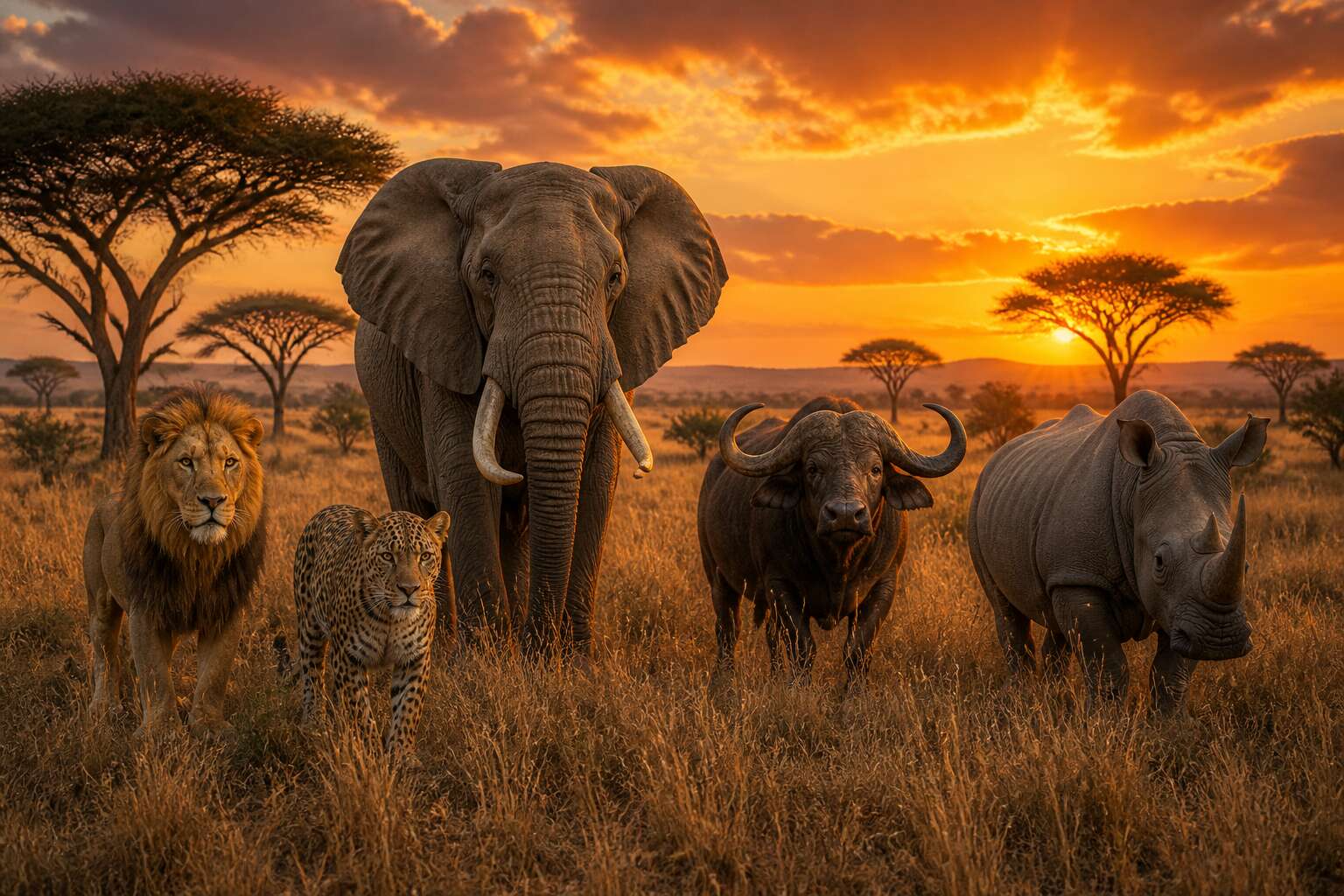
Decoding the Big Five in Kenya
Which Animals Make Up the Big Five and Why
The term Big Five was coined by hunters, not conservationists. It refers to the sheer danger of hunting these animals on foot, not their size. For those who come to Kenya today, the name has evolved into a checklist, a quiet obsession that drives conversations around campfires and fuels the hope of every early morning game drive.
The roster includes the lion, leopard, elephant, buffalo, and rhino. Each one presents a different kind of challenge to spot, a unique temperament that demands respect. The lion rules the open plains with a regal indifference. The leopard, however, is a ghost of the riverine forests, often seen only as a flicker of dappled shadow disappearing into the canopy. The elephant moves with a gravity that shakes the earth, while the buffalo, often underestimated, carries a reputation for unpredictable fury. The rhino, both black and white, stands as a relic of a prehistoric age, its presence a quiet testament to survival.
– The Big Five animals in Kenya are not defined by weight, but by the historical difficulty of the hunt.
– Their collective allure now drives a multi-million dollar safari industry.
– Spotting all five in a single trip remains a rare and celebrated achievement.
To witness them is to understand a deeper rhythm. The savannah holds its breath, a predator surveys its kingdom, and the cycle of life continues under the harsh African sun. This is the enduring magic of the Big Five animals in Kenya. They are not just wildlife; they are the living soul of a wild continent.
The Hunting Origins Behind the Term
The term “Big Five” emerged from the hunting manuals of the 19th century, a classification born from danger rather than biology. For the professional hunters who traversed the Kenyan bush, these five species presented the ultimate test of skill and nerve. The big five animals kenya were the most perilous quarry to pursue on foot, and the name cemented their legendary status in the lore of the hunt.
The list was compiled based on the specific risks involved in a close encounter. It was a matter of life and death, a calculation of aggression and resilience.
– An elephant could charge silently through thicket, devastating a hunting party with little warning.
– A wounded buffalo was known to circle back and ambush its pursuers, exhibiting a cunning that was widely feared.
– The rhino possessed a notoriously bad temper and would attack without provocation.
– Lions, while often retreating, could turn with lethal force when cornered.
– The leopard, a master of concealment, could launch a fatal strike from the canopy.
These animals earned their place on the list not for their size, but for their capacity to turn the tables. This history now influences how we observe them on safari. The danger is gone, replaced by a profound respect, but the legacy of that peril remains attached to the phrase. Understanding this origin adds a layer of gravity to the sighting of the big five animals kenya, a reminder of a time when the savannah was a far more unforgiving frontier.
Big Five vs. Other Wildlife: What Sets Them Apart
Few sights on Earth rival the quiet tension of a safari vehicle idling near a mound of rock, its shadows holding a shape that could be stone or muscle. The term “big five animals Kenya” originally described the ultimate challenge for hunters, a list of creatures that fought back with terrifying ingenuity. Today, that legacy transforms into a different kind of thrill for the observer, one centered on appreciation rather than pursuit.
What separates the elephant, lion, leopard, buffalo, and rhinoceros from the countless other species roaming the savannah is not merely their size, though that certainly plays a role. It is their historical reputation for retaliation. A giraffe might run, and a zebra might kick, but the Big Five possess a specific combination of weaponry, intelligence, and sheer unpredictability that makes them inherently formidable. To encounter them is to understand the raw, unscripted power that defines the natural order.
The Distinction of Danger
The contrast becomes clearer when you consider the ecological roles of the animals seen on a standard game drive. Most herbivores, like the wildebeest or the antelope, exist in a state of constant flight, their survival dependent on speed and herd instinct. They are prey, and their actions are predictable. The Big Five, however, operate from a position of dominance.
– The elephant uses sheer mass and complex social bonds to protect its young, and when threatened, it can turn a vehicle into a fragile toy with a single shove.
– The buffalo, often the most underestimated, uses its herds to form a defensive wall, and a lone bull is a creature of immense, volatile temper.
– The leopard relies on stealth and the element of surprise, dragging its kill into trees where competitors cannot follow.
– The rhino relies on poor eyesight but an acute sense of smell and hearing, charging with a focused aggression that is almost prehistoric in its intensity.
– The lion operates as a coalition, a unit that works with tactical precision, making an encounter with a pride a study in calculated power.
Even the heavyweights of the swamp, such as hippos, are often omitted from this list, primarily because their aggression is usually confined to their aquatic territories. The Big Five, however, are dangerous across nearly any terrain. They do not simply react to a threat; they often perceive the presence of a human as a challenge to their space, making every close encounter a genuine negotiation. This inherent unpredictability is the core difference, a distinction that transforms the phrase from a marketing slogan into a historical warning. To see them in the wild is to witness the last living link to a time when the savannah demanded absolute respect.
Quick Facts and Profiles of Each Species
I always find it useful to read the animals before I read the maps. The big five animals Kenya each follow a separate daily schedule. When you learn how to read those schedules, a safari becomes less a game of chance and more a matter of timing.
Here is the quick profile of each species:
– The elephant: large, extends to 6,000 kilograms and walks in a matriarchal family line.
– The lion: a social cat that announces its position with a low growl and moves in pride.
– The leopard: quiet, wet, and carries a fresh kill up into a tree to the high branch.
– The buffalo: a herd animal with a flat face and a sharp charge, always considered when see a motion.
– The black rhino: a solitary browser with a strong nostrils and a surprisingly military step.
That list gives you the five different temperaments. The big five animals Kenya appear when you respect the quiet time of each. The elephant keeps the midday, the rhino stays still most of the afternoon. Each profile is a kind of key.
Top Safari Destinations for Big Five Spotting
Maasai Mara National Reserve: The Lion and Leopard Stronghold
Each year, the Maasai Mara becomes the stage for the most profound wildlife spectacle on earth. The great wildebeest migration, a churning river of hooves and dust, draws the predators that define this landscape. This reserve is not merely a park; it is an ancient arena where the raw hierarchy of the savannah plays out daily. For those seeking the big five animals Kenya is famous for, this ecosystem offers an unmatched intensity of action.
The Mara’s lion prides are legendary, not just for their size but for their audacity. I’ve watched a coalition of males, their manes dark as charcoal, orchestrate a hunt along the Talek River with a brutal precision. Leopards, however, demand a different kind of patience. They are the ghosts of the riverine forests, often draped over the limbs of giant fig trees, their tails swaying like pendulums.
– The sheer density of predators here is staggering.
– Lion sightings are almost guaranteed during the dry months.
– Leopard encounters require a keen eye and a skilled guide.
Why do romantics and pragmatists alike flock here? Because the Mara provides a sense of certainty in an uncertain world. It offers the possibility of witnessing a cheetah sprint or a rhino grazing in the distance. For the dedicated traveler, this is where the pilgrimage to see the big five animals Kenya culminates in a symphony of survival.
The landscape itself is a character, vast and golden, punctuated by the distinctive flat-topped acacias. After a day of tracking, the sunset throws long shadows across the plains. I recall a particular evening, silent and still, when a leopard descended her tree and vanished into the grass, a lesson in quiet mastery. This is the Mara, a sector of the Serengeti ecosystem that guarantees drama, beauty, and the profound privilege of witnessing the big five.
Amboseli National Park: Home of the Towering Elephant Herds
Amboseli National Park shelters one of the most studied elephant populations on earth. More than fifty years of continuous research has traced these herds, revealing a matriarchal society where knowledge passes down through generations. I watched a grandmother elephant teach her grandchild to strip bark from an acacia tree, a lesson repeated until perfected. The tusks here are exceptional, some reaching nearly a hundred kilograms per elephant.
- The park remains open year-round for big five game viewing.
- The observation hill offers a panoramic view of the entire basin.
- The elephant families are accustomed to vehicles, allowing close encounters.
By midday, the elephants retreat to the shade of the doum palms. They stand motionless while their ears fan the air. The park’s rhythm slows to match the elephants’ deliberate pace. This is the big five animals Kenya experience at its most intimate.
Tsavo East and Tsavo West: The Rugged Elephant Country
Tsavo East and Tsave West form a harsh, sun-scorched territory where the elephants walk with a reddish hue, stained by the iron-rich soil. This is the big five animals kenya experience at its most raw. The herds here are battle-hardened, their tusks often scarred from centuries of survival in a land that offers no mercy.
I once watched a lone bull cross the Galana River at dusk. He paused, ears spread wide, then vanished into the thorn scrub without a sound. It felt like witnessing a ghost.
The contrast between the two parks is striking:
- Tsavo East is flat, open, and unforgiving, perfect for spotting elephant lines on the horizon.
- Tsavo West holds the Chyulu Hills and Mzima Springs, where hippos gather in clear water and leopards stalk the rocky outcrops.
- The rhino population clings to the west, guarded yet invisible.
Do not expect softness here. The big five animals kenya in Tsavo demand patience and a stomach for dust. But the reward is an encounter with the wild that refuses to be tamed.
Lake Nakuru National Park: A Rhino Sanctuary Hotspot
The rhino’s eye holds no judgment, only ancient patience. Lake Nakuru National Park shelters both black and white rhino. The big five animals kenya here demand a different discipline. I watch from a distance, letting the wind carry my scent away.
The park’s alkaline lake draws flamingos, but the rhinos stand in silence. Rangers track every individual across the acacia woodlands. This is not a zoo. It is a conservation stronghold.
For those seeking the big five, Nakuru offers a lesson in stillness. Black rhino hide in thick brush. White rhino graze open plains. Sightings come to those who wait without expectation.
Laikipia Plateau and Private Conservancies: Off-the-Beaten-Path Encounters
When travellers discuss African wildlife, the conversation inevitably turns to the Big Five. For those seeking a truly remote encounter, the Laikipia Plateau offers an experience that diverges sharply from the crowded parks. This region represents the frontier of conservation, a place where the wild still dictates the terms.
Unlike the classic safari circuits, Laikipia is defined by its private conservancies. These vast tracts of land are managed with a dual purpose: to protect the wildlife and to support the local communities that steward it. The result is an exclusive atmosphere where your vehicle might be the only one for miles, and the only sounds are the rustle of the bush and the distant call of a bird. This is where you come to see the big five animals kenya harbours in its most untamed setting.
A Different Kind of Wilderness
The landscape here is striking. It is not the lush green of the coast or the stark desert of the north. Instead, it is a tapestry of rolling hills, ancient granite kopjes, and riverine forests carved by the Ewaso Ng’iro River. This varied terrain is the lifeblood of the region, drawing elephants, buffalo, and predators to its banks.
Guided by expert trackers, you traverse this land with purpose. The absence of crowds allows for a genuine connection with the environment. A herd of elephants might cross your path, indifferent to your presence, allowing you to observe their intricate family dynamics for hours. The silence is profound, punctuated only by the snapping of a twig or the low growl of a lion resting in the shade.
The Thrill of the Chase
The wildlife viewing in this region is exceptional. The big five animals kenya boasts here are not just sightings; they are encounters. The endangered Grevy’s zebra, with its narrow stripes and large ears, roams freely alongside the more common plains zebra. Wild dogs, the most efficient hunters on the savannah, are a frequent highlight, their high-pitched social calls echoing across the valleys.
– Elephants: Large breeding herds with impressive tuskers.
– Lions: Often seen on rocky outcrops, surveying their domain.
– Leopards: Invisible by day, but a patient guide can find them draped over a tree branch.
– Rhinos: Both black and white species are protected here, offering a rare glimpse of these prehistoric creatures.
I recall a particular afternoon spent following a leopard through the dense brush at the base of a kopje. We lost sight of her for nearly an hour, the tracker’s concentration absolute. Then, a subtle flick of a tail gave her away. She was moving her cubs to a new den site. We sat, transfixed, as the mother and her two cubs moved with ghost-like grace, completely aware of our presence but utterly unconcerned. It is a moment of trust that defines the Laikipia experience.
Conservation in Action
The real story of Laikipia, however, is one of survival. The conservancies here are a model of modern conservation. They integrate cattle ranching with wildlife protection, proving that the two can coexist. The revenue from eco-tourism funds anti-poaching patrols, veterinary care, and community development projects. This direct link between tourism and preservation is tangible. When you stay here, you are an active participant in the safeguarding of these species.
This is the heart of why the big five animals kenya protects are so vital. It is a delicate balance. The land is shared, and the benefits are shared. The result is a sanctuary that feels both wild and secure, a place where the future of the elephant and the leopard is intertwined with the prosperity of the people who live alongside them.
So, when planning your journey, look beyond the traditional circuits. Venture into the wilds of Laikipia. Here, you will not simply tick off the big five animals kenya is famous for; you will witness them in a context of true wilderness, and in doing so, you will contribute to their lasting legacy. The experience is raw, honest, and profoundly moving. It is safari at its most authentic.
Seasonal Guide to Maximizing Big Five Sightings
Dry Season vs. Green Season: Which Is Better
Choosing between Kenya’s dry season and green season often changes your safari experience entirely. Most visitors agree that the dry months from June to October offer the most reliable sightings for the big five animals Kenya is famous for. During this time, sparse vegetation and shrinking water sources pull wildlife into concentrated areas, making elephants, buffalo, and lions easier to track. Predator activity peaks, especially around permanent rivers, which fuels dramatic encounters.
The green season, running from November to May, presents a different kind of magic. While the bush becomes thick and animals spread out, this period rewards patient travellers with newborn calves and a burst of avian life. You might find the big five animals Kenya hosts, but the search requires more time and a skilled guide. The landscapes shift to vibrant emerald, and the light after a storm creates stunning photography conditions.
Here is a practical breakdown of the dry season advantages:
– Water sources shrink, forcing wildlife into predictable zones.
– Thinner foliage reduces visual barriers for spotting leopards.
– Dusty roads make tracking fresh prints far easier.
If your priority is ticking off the full list of the big five animals Kenya offers, the dry season gives you the highest probability. However, if you prefer fewer crowds and a more intimate, green backdrop, the wet months hold their own appeal. Consider what matters more to you: guaranteed sightings or lush scenery and solitude. Both seasons provide a window into one of Africa’s greatest wildlife arenas, so the right choice simply depends on your personal travel style.
The Great Migration and Its Effect on Predator Viewing
Each year, the great wildebeest migration funnels over a million hooves into the Maasai Mara. This event is the single most disruptive force in the ecosystem, and it recalibrates the hunting patterns of the big five animals Kenya supports. Predators do not hunt constantly. They capitalise on opportunity, and the migration is a rolling buffet.
The influx of exhausted herds changes the calculus for lions and leopards. A healthy wildebeest is difficult to catch. The sick, the young, and the laggards become the targets. Crocodiles wait at the river crossings. The drama is not subtle. It is a raw, visual equation of survival that plays out daily in the grasslands.
– River crossings compress prey into narrow channels, creating ambush points for big cats.
– The sheer volume of prey means predators become lethargic and easier to observe during the day.
– Territorial pride dynamics shift as nomadic males follow the herds, increasing conflict.
For the traveller, this means the action is not always in the bushes. Between July and October, the focus shifts to the riverbanks and the open plains. The big five animals Kenya hosts are still present, but their behaviour is dictated by the moving mass of protein. You do not need to track a lion. You simply find the herd and wait. The predators will arrive on their own schedule.
Peak Morning and Late Afternoon Game Drive Windows
The first game drive of the day rewards the early riser with the most honest wildlife encounters. The big five animals kenya move with purpose in the cool morning air, and again as the sun drops toward the horizon. Noon forces everything to rest, including your chances of spotting a lion on the move. Plan your drives around these two peaks:
- Morning window: 6:30 to 9:00, when predators finish nocturnal hunts.
- Late afternoon window: 16:00 to 18:30, when heat stress fades and activity resumes.
These hours align with the natural rhythms of prey and predator. You trade a comfortable sleep for an unobstructed view of the big five animals kenya. The light also works in your favour, casting long shadows that reveal shapes hidden in the grass.
Conservation Landscape for Kenya’s Big Five
Black and White Rhino Recovery Stories
Kenya’s black rhino population collapsed to around 300 animals in the early 1980s. Three decades on, the combined black and white rhino count has passed 1,500, and the big five animals kenya checklist now includes a mammal that nearly vanished.
The conservation landscape is divided between public reserves and private conservancies. Success depends on coordinated measures:
- Translocation projects move rhinos into community lands.
- Dehorning reduces poaching incentives.
- Rangers and sniffer dogs monitor high risk zones.
I once tracked a black rhino on foot in Laikipia, watching its dark shape disappear into the acacia thicket. That moment depends on an unglamorous network of vets, scouts and census teams. For visitors, the rhino remains the hardest of the big five animals kenya to spot, and the most rewarding to find.
Human-Wildlife Conflict and the Role of Community Conservancies
A single elephant can flatten a season of maize in one night. In northern Kenya, that is the everyday cost of human wildlife conflict. Farmers who once poisoned lions now earn from their presence through community conservancies.
These conservancies build a buffer between wild land and farmland. They pay grazing fees, compensate herders for lost livestock, and fund scouts who track problem animals.
- Predator compensation is paid within weeks, not years.
- Water points are shared by wildlife and domestic herds.
- Local rangers mediate when a break in the fence occurs.
This constant negotiation determines how the big five animals kenya are valued by the people who live beside them. One family in northern Kenya lost three goats to a leopard, yet still voted to keep the conservancy alive. That is the practical side of coexistence!
Anti-Poaching Units and Modern Tracking Technology
Poaching syndicates in Kenya now face a different kind of adversary. Anti-poaching units deploy thermal drones and acoustic sensors that listen for chainsaw vibrations and gunfire. A rhino’s ear notch once served as a simple identifier. Today, every movement of a collared elephant transmits data to command centres in Nairobi.
- Real time GPS collaring decodes migratory corridors.
- AI powered camera traps distinguish poachers from tourists.
- Canine units track scents across rugged terrain.
These technologies secure the perimeter around the big five animals kenya. Rangers monitor anomalies before they escalate. One arrest in Tsavo yielded intelligence that dismantled a trafficking ring. This quiet digital vigilance defines modern conservation.
How Safari Fees Fund Local Wildlife Protection
Kenya’s conservation landscape runs on tourist money. Every park entrance ticket, bed levy and safari permit feeds a budget line that pays ranger salaries, fuels patrol vehicles and maintains park infrastructure. Visitors paying to see big five animals kenya are not passive observers. They are the budget.
The flow is direct. Park fees become fuel, vehicle parts and rations for patrol teams. Part of the money pays informants who tip off rangers about planned poaching operations. Part funds veterinary units that treat wounded wildlife. This is how protection gets budgeted.
Consider the anatomy of one safari fee:
- A portion covers park operations.
- A portion funds community programmes near park borders.
- A portion trains rangers in tactical response.
The traveller who grumbles about a 5 a.m. wake-up call is contributing to that system. I know because I have been that traveller. That is the quiet bargain of Kenyan conservation.
Expert Tips for Planning a Big Five Safari in Kenya
Choosing Between Self-Drive, Guided Safaris, and Fly-In Trips
Choosing your transport is the first test of any big five animals kenya adventure. I have watched self-drive travellers lose half a morning to a flat tyre near Tsavo, while guided groups cruised past with spare tyres and cold water. Self-drive offers raw freedom, but it demands patience with rocky tracks and unreliable road signs. Guided safaris put seasoned trackers in control, turning a distant grass ripple into a lion sighting before the engine even cools.
Fly-in trips cut travel time drastically. A forty minute hop from Nairobi to the Mara replaces a full day of driving, leaving more hours for elephant herds and rhino sanctuaries. Before booking, weigh what matters most:
- Self-drive for total flexibility
- Guided safaris for expert spotting
- Fly-in for speed and comfort
Each option shifts the rhythm of your search. Dust, fuel stops and road conditions shape your memories as much as the animals themselves.
Packing Essentials and Recommended Field Attire
A single missed layer can turn a perfect morning into a shivering wait for the thermos. Planning for big five animals kenya demands field attire that breathes in midday heat yet holds warmth at dawn. I learn this on every trip. Neutral colours matter more than fashion; olive, khaki and sand blend with bush shadows, while navy and black stand out to sensitive eyes.
Pack light but deliberate. My core kit includes:
- Moisture wicking base layers
- A fleece jacket for the 6 am chill
- Convertible trousers with zip off legs
- Wide brimmed hat and fingerless gloves
Waterproof boots are non negotiable for wet grass! Binoculars with a 10×42 lens give you the distance you need without exhausting your neck.
Camera Gear and Photography Techniques for Close Encounters
The light at dawn in the Maasai Mara shifts minute by minute. I keep my camera settings ready before the engine starts, because the big five animals kenya do not wait for you to adjust your ISO. A shutter speed of 1/1000 freezes the sudden charge of a lioness or the flick of an elephant’s ear!
For close encounters with the big five animals kenya, I favour a 400mm lens with image stabilisation. Resting it on a bean bag draped over the vehicle door frame gives stability without the weight of a tripod. My settings vary with the light:
- Shutter priority at 1/1000 for moving predators
- Aperture wide open for soft backgrounds
- Auto ISO capped at 3200
Switch off autofocus when animals are behind grass. The camera hunts, you curse, the moment vanishes. Manual focus gives control in those tangled, golden seconds.
Wildlife Viewing Etiquette and Safety Rules
Nobody controls the big five animals kenya. You plan around them. I always advise choosing a lodge or conservancy with a strict vehicle-to-animal ratio. You want space, not a convoy of vans crowding a single leopard sighting!
Etiquette on the track is simple: silence, patience, and respect. Switch off the engine near kills. Let the guide speak first. Flash photography can startle a lion and ruin a rare moment.
Safety rules are non-negotiable:
- Stay seated inside the vehicle at all times.
- Never stand or lean out to take a photo.
- Keep arms and legs inside the vehicle windows.
- Follow the guide’s instructions without debate.
The vehicle protects you. A buffalo will charge a person on foot but ignore a stationary car. Understanding that boundary keeps you alive while watching the big five animals kenya.
Visa, Vaccination, and Travel Preparation Checklist
Planning a safari to see the big five animals kenya requires smart preparation, not just a packed suitcase. Sorting out the administrative side of your journey months in advance is the single most effective way to reduce stress. The visa process for Kenya is straightforward, but it requires attention to detail that many travellers overlook.
Your checklist should start with the essentials before you even think about binoculars.
– A valid passport with at least two blank pages and six months of validity.
– An e-visa application submitted online at least two weeks prior to departure.
– A yellow fever vaccination certificate, mandatory if travelling from an endemic zone.
– Travel insurance that explicitly covers emergency evacuation from remote reserves.
Malaria prophylaxis is a serious consideration for the Maasai Mara and Amboseli. Speak to a travel health specialist about which antimalarial suits your medical history. Furthermore, carry a basic medical kit, but note that your lodge can usually assist with minor ailments. Most camps have access to a doctor via radio, but a personal supply of rehydration salts and antiseptic wipes is sensible.
Packing for the big five animals kenya means neutral colours that blend into the bush, long sleeves for the evening, and a lightweight waterproof layer for unexpected showers. Compact power banks keep your camera and phone alive during long game drives, as some remote camps have limited charging stations. Finally, make physical and digital copies of all travel documents and store them separately in your luggage, a precaution that can save your trip if a bag goes missing.

0 Comments