Understanding the Big Five: Definition and Origin
The term “Big Five” was never meant for tourists. It emerged from the hunting grounds of 19th century Africa, where colonial hunters ranked these creatures by how difficult they were to approach on foot. The africa big five animals earned their reputation through sheer defiance, not popularity.
Each species became a marker of survival skill. Hunters spoke of the lion’s audacity, the leopard’s stealth, the elephant’s fury, the buffalo’s tenacity, and the rhinoceros’s unpredictable charge. I find that origin deeply telling. It shifts our modern gaze from safari photos to a raw, historical reality.
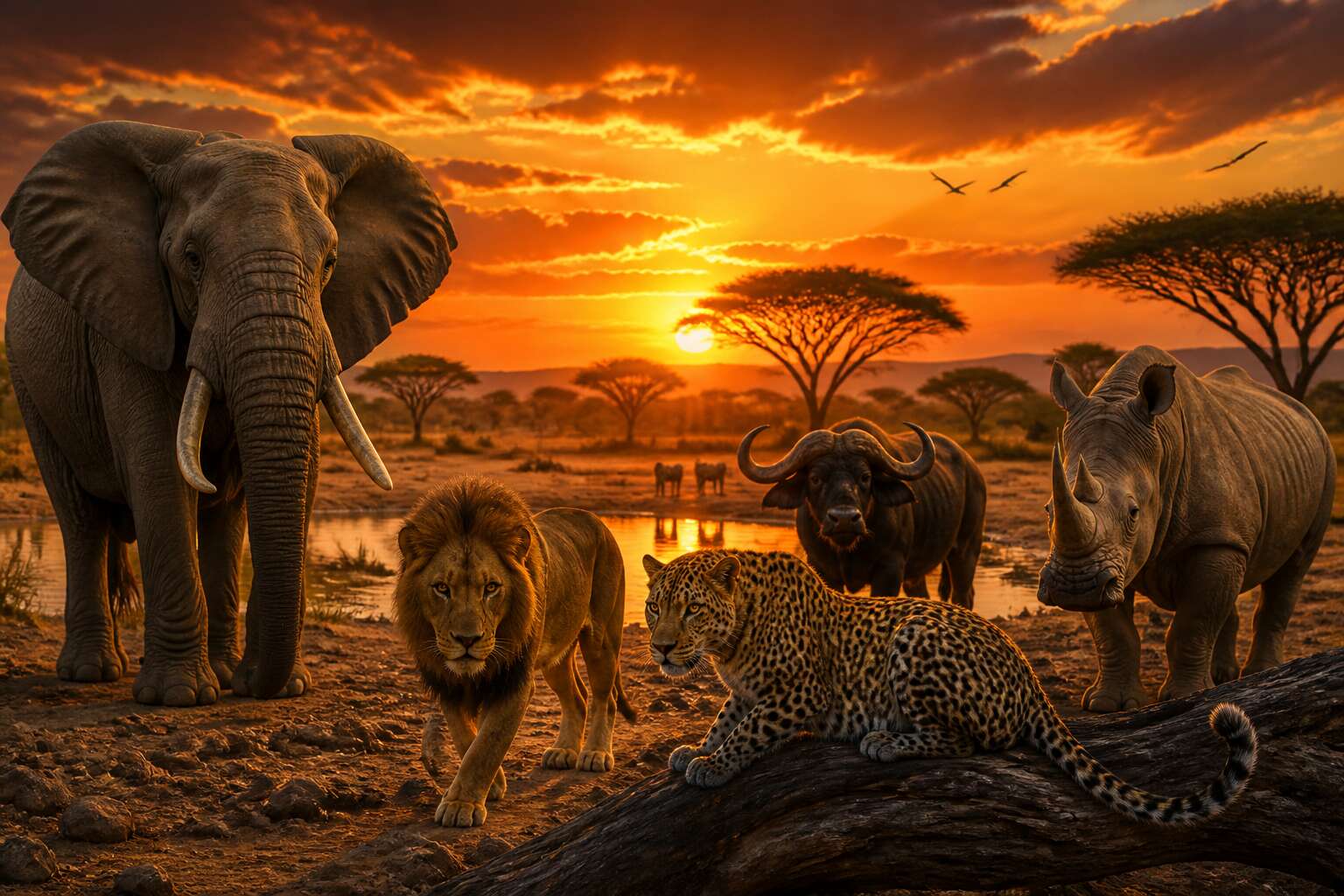
Today, conservationists still use the term, but with a different weight. To see them now is to witness resilience. Consider the sheer physical presence of these five:
- The African elephant, weighing up to six tons
- The lion, whose roar carries five kilometres
- The leopard, a solitary phantom of the branches
- The Cape buffalo, known for circling back on threats
- The rhinoceros, ancient and armour-plated
That definition remains a portal into Africa’s wild history, and a quiet challenge for any traveller.
Meet the Big Five: Key Species Profiles
Nobody is neutral about the big five. People fly across the world and spend fortunes just to lay eyes on them. They are the bucket list icons, the reason your safari vehicle brakes hard on a dusty track. The africa big five animals are not strictly the largest creatures on the continent. They are a curated list of the most formidable, the most dangerous, and the most exasperating to track on foot.
The elephant is the heavyweight, a walking demolition permit with a memory that holds grudges for decades. A bull can push over a tree that took a century to grow, just because it was in his way. Then there is the rhino, who is essentially a tank with poor eyesight and a short fuse. Do not mistake its grazing posture for calm; it is merely deciding which of your bones to break first. The buffalo, often overlooked, is the veteran of the group. He looks at you like an old soldier who has seen every trick in the book and is profoundly unimpressed by your presence.
The cats, of course, steal the show.
– The lion is the socialite, ruling the pride with a mix of laziness and sudden, violent efficiency.
– The leopard is the cryptid, the ghost that you see for three seconds before it melts back into the tree line.
That leopard is the one that keeps your guide honest. You will spot the others with relative ease, but earning a leopard sighting requires patience and a bit of luck. These are the true stars of any africa big five animals safari, and seeing all of them in one trip is the ultimate bragging right. It is a rare achievement, and it usually involves a lot of waiting, a lot of coffee, and a guide who knows the bush better than he knows his own living room.
Best Places to See the Big Five in Africa
Everyone has a list. The africa big five animals are the reason most people book a safari, and seeing all five in one trip is a rare statistical treat. South Africa offers the best odds. Kruger National Park is the classic choice, but the private reserves of Sabi Sands deliver sightings with near military precision. Try these for the fullest experience:
- Sabi Sands for leopard encounters.
- Hluhluwe-iMolozi for rhino populations.
- Madikwe for a malaria free option.
The lions here loaf in the open. Elephants amble past with practiced indifference, while buffalo stare back at you, unimpressed. You might leave with dust in your boots. You will definitely leave with stories.
The Big Five and Conservation Challenges
Lion populations across the continent have plummeted by more than 40% in just three generations. That is a staggering loss for creatures many of us grew up believing were untouchable. The Africa Big Five animals, the elephant, rhino, buffalo, leopard, and lion, are more than a tick list for a safari. They are the beating heart of our wild spaces, and they are in trouble.
The challenges these species face are deeply complex, and they are woven into the very fabric of our rural communities. It is not simply about poaching, though that remains a brutal reality. The pressure comes from a slow, grinding loss of habitat as human settlements expand. When we talk about the Africa Big Five animals, we are also talking about the people who live alongside them, often carrying the cost of coexistence.
Consider the core threats that conservationists are battling daily:
– Habitat fragmentation that isolates breeding populations and reduces genetic diversity.
– The illegal wildlife trade, driven by demand for ivory and rhino horn.
– Climate change, which alters water sources and prey availability.
– Human-wildlife conflict, where a single lost cow can turn a community against a predator.
These issues are interconnected, and solving them requires patience. I have seen the weariness in a farmer’s eyes after a leopard has taken his livestock, and I have also seen the pride in a ranger’s stance as she tracks a matriarch elephant. The future of the Africa Big Five animals depends on finding a balance between these two worlds. It is a delicate, ongoing negotiation between the wild and the everyday.
Planning a Big Five Safari
Only 4,000 lions remain across the African continent, a number that makes every sighting feel like a rare privilege. Planning a Big Five safari in South Africa demands respect for distances and the seasonal rhythms of the bushveld.
The africa big five animals are the reason most visitors cross this terrain, but the true art lies in your preparation. I always base my itinerary around water sources, because that is where the tension of the bush unfolds. These practicalities often structure the day:
- First light game drives to catch nocturnal predators returning.
- Midday rest to avoid the harsh heat and the tourist flow.
- Evening sundowners that often yield the most dramatic interactions.
You need at least three days per reserve to acclimatise to the territory. These apex predators demand patience, not speed. Give yourself the time to simply sit and watch the landscape shift!
Big Five Myths and Misconceptions
The term “Big Five” is a fabricated construct, a relic of a bloodier age than our own. It was never about the five most majestic creatures. It was about the five most dangerous to hunt on foot. This distinction is crucial for any modern safari, yet it remains the seed of countless myths.
The greatest misconception is that these animals are merely a checklist. People whisper about the “africa big five animals” as if they are trophies to be ticked off a bucket list. The reality is far more complex. The elephant’s ancient, weathered memories are often mistaken for simple aggression. The buffalo, often dismissed as a common bovine, is a silent, hulking shadow of pure vengeance when wounded. It is not a creature to be trifled with.
Consider the realities of their defensive behaviors:
1. The leopard is a phantom, rarely seen, and its elusiveness is a sign of intelligence, not rarity.
2. The rhinoceros, burdened by its own armored history, suffers from terrible eyesight, a vulnerability that breeds a defensive rage.
3. The lion’s roar is a social signal, not merely a warning of impending attack.
The true danger is not their aggression, but our misunderstanding of their fear. The africa big five animals are not actors on a stage for our amusement. They are survivors of a landscape that demands constant vigilance. We project stories onto them, forgetting they are simply existing, in a world that grows ever smaller for them. The true safari is about seeing them for what they are, not what we fear they might be.



0 Comments