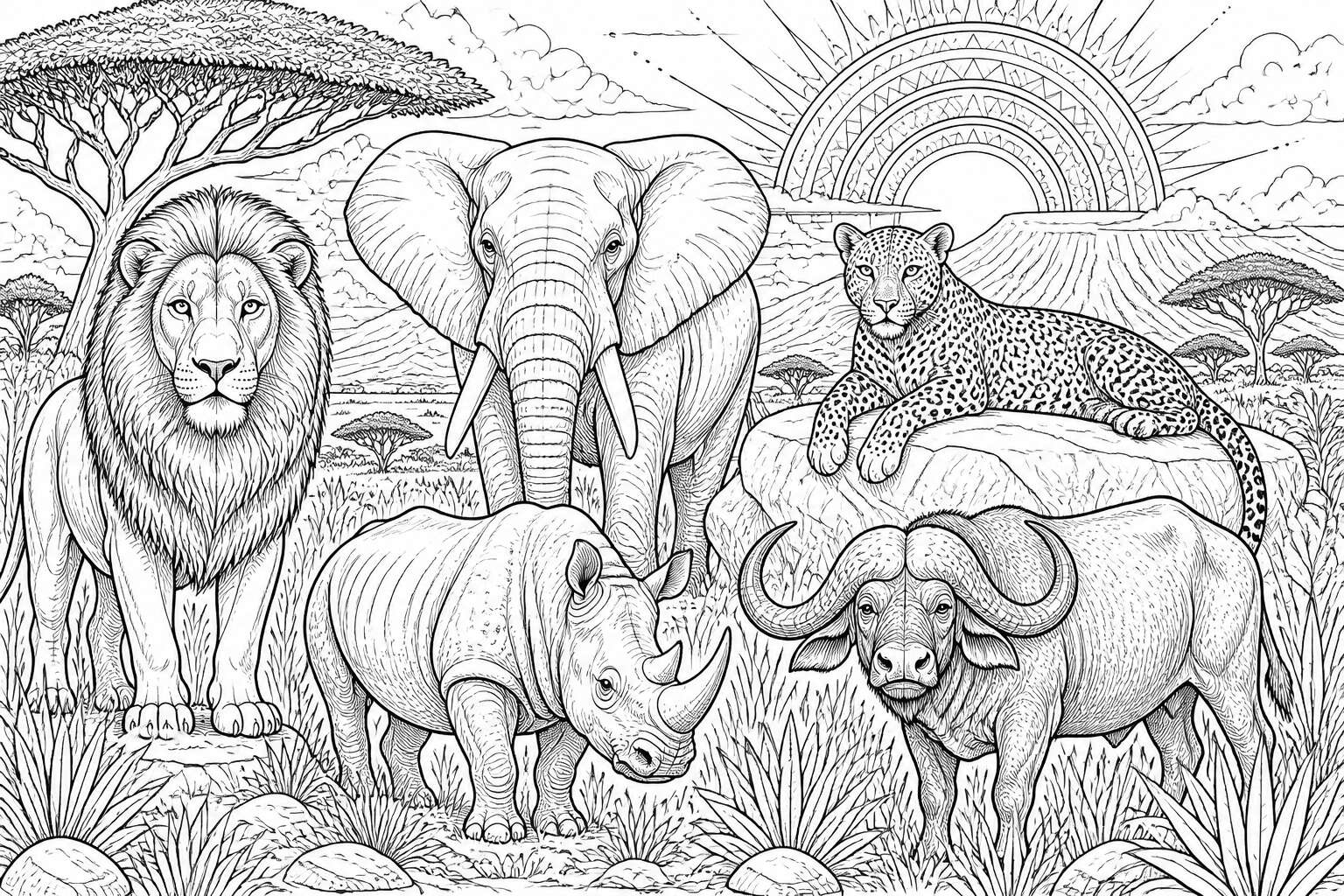
The Fascinating World of the African Big Five
Origins of the Big Five Safari Term
The Big Five safari term began as a lethal checklist. In the late 1800s, professional hunters pursued elephants, lions, leopards, Cape buffalo, and rhinos because these species fought back hardest when tracked on foot. Surviving such an encounter earned a hunter legendary status.
- African elephant
- Lion
- Leopard
- Cape buffalo
- Rhinoceros
That violent heritage now fuels a gentler pastime! Big five colouring pages let you revisit these animals as icons of wild beauty, not targets. Each stroke of a crayon turns a hunting relic into a moment of quiet appreciation, perfect for rainy afternoons in Johannesburg or a classroom in Cape Town.
Physical Features and Habitats of Each Animal
An elephant’s ear spans two metres, and no two leopards share the same rosette pattern. Each of the Big Five claims a distinct role in the landscape. The African elephant shapes the ground, its tusks digging for water across savanna and woodland. Leopards, solitary climbers, haul prey into acacia trees, thriving from riverine forests to rocky mountains.
Lions dominate open grassland, their tawny coats blending into dry grass. Cape buffalo gather in vast herds on wetter plains, their fused horns forming a solid boss across the skull. Rhinos split the habitat neatly: white rhinos graze short-grass plains, while black rhinos browse dense thickets.
Key features to spot in big five colouring pages:
- Elephant: enormous ears that radiate heat
- Lion: a dark mane that signals strength
- Leopard: rosette markings for camouflage
- Buffalo: a downward-curving horn boss
- Rhino: thick, folded skin
Big five colouring pages reward patience. Each picture becomes a quiet study of animal form and habitat.
Conservation Status and Why They Matter
Most safari tourists do not realize they are looking at some of the most expensive animals on Earth. The Big Five generate millions in tourism revenue each year, funding anti-poaching patrols and habitat expansion across South Africa. Their survival is tied directly to their value as living attractions.
The conservation status of these species is a mixed report card:
- Lion: vulnerable, with sharp declines in West Africa
- Leopard: near threatened, though their secretive nature masks true losses
- Elephant: endangered in parts of the continent
- Black rhino: critically endangered, still losing ground to poachers
- Buffalo: least concern, with stable numbers
Big five colouring pages let you study each animal without rushing. That focus builds familiarity, and familiarity is precisely what keeps conservation funded.
Why Colouring Pages Featuring Wild Animals Are Great for Children
Enhances Fine Motor Skills and Hand-Eye Coordination
A child’s grip on a crayon is a small triumph of intention. When they colour the lion’s mane on big five colouring pages, they control every stroke. The intricate spots of a leopard or the folded skin of a rhino demand precise hand movements. This practice builds fine motor skills, strengthening the small muscles in fingers and palms. Hand-eye coordination also sharpens as a child watches the crayon tip and guides it within the boundaries.
The concentration is palpable. I have seen a young one tilt the page, adjust their grasp, and pause to admire the effect.
- Firm grip development for future pencil work.
- Enhanced visual tracking across complex shapes.
These big five colouring pages offer a quiet, focused activity where a child’s dexterity meets the complexity of the savanna.
Sparks Creativity and Imagination Through Wildlife Themes
A lion rendered in purple with a chartreuse mane is not a wildlife error. It is a creative decision! Big five colouring pages give children a stage where the savanna’s most serious characters become anything they wish. The rhino can wear a crown. Imagination outranks accuracy.
The wildlife theme provides familiar content. Children know these animals from stories and the Kruger. Colouring turns them into participants. They ask what the leopard is thinking or where this buffalo wandered from. The page becomes a prompt for stories no field guide would sanction.
- A rainbow-spotted leopard patrols a river of their own making.
- A buffalo stars in a rescue involving a stuck tyre swing.
- An elephant holds a summit with garden birds about snack distribution.
Big five colouring pages rarely come out the same. A blank page asked for a lion and received a story instead.
Teaches Focus and Patience in a Fun Way
Completing a single sheet from the big five colouring pages takes time. A child deciding whether the buffalo’s horns should be charcoal or brown must sit with that choice. This quiet deliberation builds patience without feeling like a chore.
These pages demand prolonged attention. The leopard’s rosettes and the elephant’s creased skin need a steady hand and a settled mind. Children who rush soon learn that slowing down leads to a better result. They see the difference in their own work.
The finished page stands as proof that sustained concentration pays off. For a young mind in an instant world, that is a valuable discovery.
Introduces Kids to Conservation and Nature Appreciation
Colouring a lion’s mane or tracing a rhino’s horn does more than occupy small hands. It creates a silent bond between a child and the animal on the page. When a child chooses the exact shade for an elephant’s skin, they pause to consider that animal’s reality. That pause becomes the seed of conservation awareness.
Big five colouring pages turn abstract concepts into tangible images. A child who colours a buffalo learns to recognise its shape and presence. Later, seeing that same buffalo in a game reserve triggers recognition, not fear. This familiarity builds respect.
Consider what a child absorbs while colouring:
- The leopard’s spots mirror its habitat.
- The elephant’s tusks tell a story of survival.
- The lion’s posture speaks to its role.
These small observations plant a sense of stewardship. Nature becomes something to protect, not just admire.
Provides a Screen-Free Entertainment Option
Screen time is the default remedy for restless children, but it drains more than it gives. Big five colouring pages provide a different kind of attention. A child trades a flickering feed for a blank page and a single task. This is entertainment that slows the pulse.
The activity holds meaning. When a child shapes a buffalo’s silhouette or selects a shade for the lion’s mane, the hand and mind work together. In my experience, big five colouring pages keep a child engaged longer than any video. For parents in South Africa, this makes them an easy choice for trips, load shedding, and rainy afternoons.
What a screen-free moment can include:
- The scratch of pencil against paper
- The smell of wax and wood
- The quiet pride in a finished ear
These details are modest, but they build a child’s inner world. No subscription, no signal, no battery. Just a page and a story.
Creative Ways to Use Safari Animal Colouring Pages
Create a Homemade Activity Book with Lions, Giraffes, and More
Making a homemade activity book with the big five colouring pages turns a simple pastime into a lasting project. Gather the finished lion, giraffe, elephant, rhino, and buffalo pages, then bind them with ribbon or staples. Insert blank sheets between the artwork so children can add their own notes or draw extra scenery.
- Cut out animals to create puppets for storytelling.
- Use the pages as templates for tracing onto fabric.
- Add a checklist for spotting animals during a game drive.
This method encourages children to revisit their work and build on it over time. It also gives parents a simple way to organise their collection without wasting paper. I have used this with my own kids, and the book becomes a favourite item on the shelf!
Design Unique Birthday Party Decorations and Invitations
A birthday party dissolves in hours, but the preparation reveals what a family values. Using big five colouring pages as a base for decorations forces a pause. A child colours an elephant, and that act becomes a signature of the day.
For invitations, fold cardstock and trace the same animal. Let the child add a mane or a tusk. The resulting cards are never identical, and that imperfection is the charm.
- Hang pages as bunting.
- Place them under plates as mats.
- Staple a few into a small programme.
These coloured sheets carry the party’s spirit home. Months later, a faded rhino on the fridge recalls the laughter, not the mess.
Turn Coloured Pages into Educational Flashcards
Once a lion or elephant emerges from a colouring sheet, it can become a tool for learning. Cut the animal out and paste it onto cardstock. On the reverse, write a fact about its size, diet, or behaviour. These homemade flashcards carry a child’s own artwork into their memory. Use them for quick recall games or quiet afternoons.
- Sort the cards by habitat, from savannah to riverine forest.
- Arrange them by weight, lightest to heaviest.
- Match each animal to a conservation status.
A set of big five colouring pages yields five sturdy cards, each one an entry point into a wider conversation about the bushveld.
Use Them for Group Art Projects in Classrooms
A single A1 sheet spread across four desks alters the group dynamic in a classroom. When learners gather around big five colouring pages for a group mural, the task becomes one of negotiation and shared ownership. Some children instinctively claim the lion, others drift toward the elephant. The teacher switches between guiding colour choices and settling disputes over territory.
- One child sketches the background habitat.
- Another mixes and tests colour combinations.
- A third checks animal proportions while the group colours.
The finished artwork matters less than the process. A group that completes a single buffalo or rhino page has practised patience, verbal compromise, and the discipline of waiting for a turn. Those are skills no workbook can measure.
A Guide to Finding High-Quality Printable African Wildlife Colouring Pages
Search for Free vs. Paid Colouring Sheet Options
Hunting for the perfect big five colouring pages online can feel overwhelming, especially when search results return thousands of images of wildly varying quality. I have learned to look past the first page of thumbnails. A high quality printable should have crisp outlines, accurate animal proportions, and enough interior detail to suit the child’s age.
Free options often come from educational blogs or conservation organisations, and they can be wonderful. Those pages frequently carry watermarks or lower resolution scans, so inspect the preview carefully. Paid collections usually provide clean vector files and multiple poses for each animal.
- Prioritise PDF downloads over compressed JPEG images.
- Check the resolution before committing to a print run.
- Review the licence if you plan to share copies.
Weigh the cost against the intended use. A single paid pack of big five colouring pages can serve birthdays, classrooms, and quiet weekends for years, while free sheets are ideal for sampling a theme without any investment.
Consider the Complexity Level Based on Age Group
Choosing the right complexity level for big five colouring pages can determine success or frustration. A toddler handed a highly detailed lion mane will struggle, while a ten-year-old may find a simple elephant outline dull. Match the line weight, interior detail, and pattern density to the child’s developmental stage.
Thicker outlines work best for younger children. They provide clear boundaries for emerging motor skills. Older kids need sheets with intricate fur textures and open savannah backgrounds. Print quality matters too. A crisp PDF keeps lines clean after enlarging.
When sorting through big five colouring pages, check the age range stated by the creator, the number of elements on each page, and whether the composition feels cluttered or spacious. The right match builds confidence and keeps young artists engaged from the first stroke to the final colour.
Look for Detailed and Realistic Illustrations
Crisp lines and accurate anatomy separate a high quality printable from a quick sketch. The big five colouring pages worth your printer ink show shading, fur direction, and correct proportions. A lion’s mane should not look like a cloud. An elephant’s skin needs wrinkles that follow the body’s curve.
Check the resolution before you commit. A low resolution PNG breaks down into jagged edges when scaled. PDF files preserve the illustration’s integrity. Look for sheets that place the animal in its natural landscape rather than a blank white box.
- Examine the detail in the eye and muzzle
- Compare the size of the ears to the head
- Look for background elements that add context
Realistic illustrations teach accurate colour placement. They encourage a child to observe reference photos and apply what they see. The big five colouring pages that offer this depth hold attention for longer stretches and produce results worth framing.
Check Print Compatibility and Paper Size
Print compatibility separates a rewarding project from one that wastes ink and temper. Most home printers handle standard A4, but borderless settings can crop the elephant’s tusks exactly where you do not want them. Before you download big five colouring pages, open the file properties and check the actual paper size declared by the artist. A sheet designed for A3 will shrink awkwardly onto A4 unless you adjust the scaling ratio.
- Confirm the PDF embeds colour profiles instead of relying on screen previews
- Run a single test page on plain paper before using your good stock
- Check the minimum margin your printer requires, usually around 5 mm
Paper weight changes the entire experience. For big five colouring pages, 120 gsm cardstock holds pencil shading without bleed, while lightweight copy paper wrinkles under felt tips. The finish matters too. A glossy surface makes wax crayons slip, whereas a matte texture grips the pigment. Match the medium you plan to use, and the printed page will honour the original illustration. Realistic detailing only survives if the print resolution stays sharp at the chosen dimension.
Explore Various Artistic Styles such as Cartoon or Realistic
The artistic style determines whether a page gets finished or abandoned. Cartoon big five colouring pages win over young children with bold outlines and exaggerated features. Realistic big five colouring pages challenge older hands with textured fur, layered shadows, and accurate anatomy. Quality African wildlife colouring pages balance both approaches.
Examine the line work closely. A skilled artist varies stroke thickness to guide the eye. Weak digital conversions flatten those details. Seek preview images showing actual artwork, not mockups. Independent artists often provide free sample sheets.
- Elephant tusk curvature that holds natural proportion
- Lion mane lines that suggest depth instead of clutter
- Leopard rosettes that follow the body contour
These small tests separate polished illustrations from rushed derivatives. The rhino’s horn angle and the buffalo’s horn sweep reveal the artist’s understanding of their subjects.
Read Reviews and Ratings for Premium Packs
A single review can save you from a disappointing download! Premium big five colouring pages promise rich detail, yet not every pack delivers. I always scan ratings for comments about line clarity and print quality before spending a cent.
Reviews reveal practical details that preview images hide. For example, does the lion’s mane hold up at A4 size? Are the elephant tusks properly proportioned on every sheet? Look for buyers who mention paper texture and ink usage, since those affect your experience.
- Check for photos of printed pages, not just digital mockups.
- Note any repeated complaints about pixelation or distorted anatomy.
- Prioritise packs with recent positive reviews from South African users.
Premium collections often earn their price through consistent line work and accurate species representation. Reading between the ratings helps you choose once, not repeatedly.
Tips for Making the Most of Your Colouring Sheets
Select the Best Tools for Effortless Colouring
For many, the appeal of big five colouring pages lies in the tension between the roar of the wild and the quiet of the page. Yet that serene experience can become a battle with the wrong materials. Selecting the correct instruments transforms a simple task into a ritual of focus. A heavyweight paper is non negotiable, as it prevents the bleed that ruins intricate fur patterns. Pencils with soft lead lay down pigment smoothly, allowing you to layer colours for depth without gouging the surface.
To elevate your finished artwork, consider the tactile response of your medium. Colour reacts differently depending on the tool that applies it.
– Use watercolour pencils with a damp brush for a subtle grayscale wash on the elephant’s hide.
– Try gel pens for the rhinoceros’s horn to create a slick, reflective sheen.
– Choose a fine liner for the leopard’s spots to ensure crisp, defined edges.
Achieving a lifelike finish on the lion’s mane is a matter of pressure control, not speed. The grain of the paper itself becomes your ally when you intend to blend, holding the pigment in place while you soften the transitions between light and shadow.
Turn Colouring Time into a Learning Opportunity
Every outline on a big five colouring page carries a lesson. The elephant’s wrinkles tell a story of drought and survival. The rhino’s armour speaks to ancient defence mechanisms. When children colour these sheets, ask them what they see. Let them question why the lion rests beneath the thorn tree instead of hunting during the heat.
Turn the activity into a quiet investigation. Research the animals together. Discuss the difference between a white rhino and a black rhino, or why the buffalo keeps oxpeckers on its back. The page becomes a starting point for conservation conversations.
- Identify the distinguishing marks of each animal.
- Find their tracks and droppings in field guides.
- Map where each species roams in South Africa.
Organize a Fun Colouring Contest at Home or School
Monotony is the quiet enemy of any creative session. Organize a fun colouring contest at home or school to reignite interest. Hand out big five colouring pages and lay out a mix of crayons and pencils. Set a timer for fifteen minutes. The silence that follows is productive, as children lose themselves in the leopard’s spots or the elephant’s forehead. In a classroom, let learners work in pairs, each one studying a different animal. They can swap pages halfway and add details the other missed. This cooperative contest deepens visual literacy.
- Praise unusual colour choices to free their imagination.
- Let each child explain their work, which builds confidence.
The finished pages become exhibits worth discussing.


0 Comments