Foundations of the Big Five Personality Model
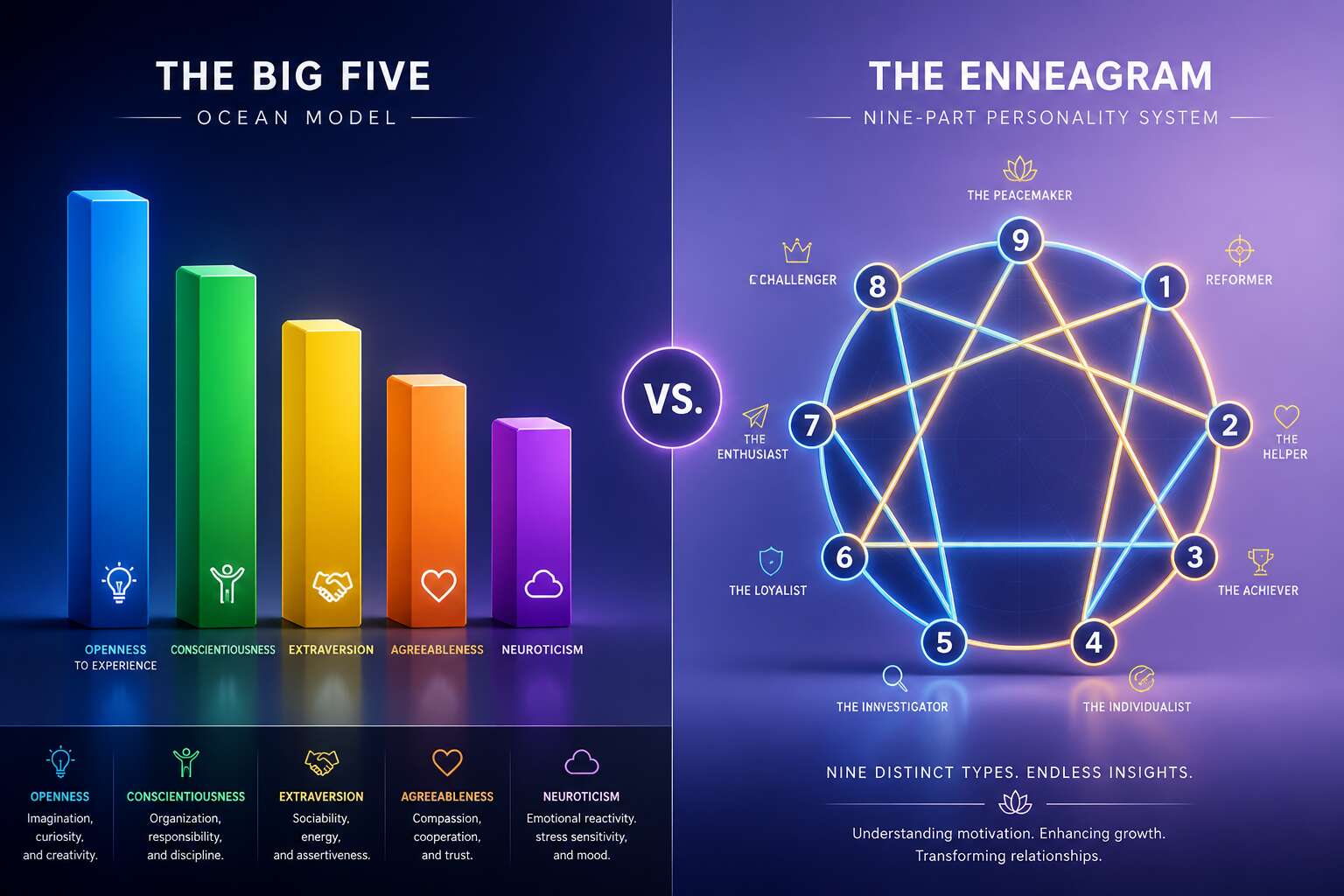
The Five Broad Traits: OCEAN Explained
Psychologists call the Big Five a taxonomy, not a story. It measures observable patterns, while the Enneagram digs into hidden motives. For anyone weighing the big five vs enneagram, this difference matters!
- Openness: curiosity for new experiences and abstract ideas.
- Conscientiousness: self-discipline and goal-directed behaviour.
- Extraversion: energy drawn from social engagement.
- Agreeableness: cooperation and empathy.
- Neuroticism: sensitivity to negative emotions.
I have seen clients use these dimensions to map career fit, team dynamics, and personal growth. Each trait sits on a continuum, which gives the model a level of precision many typologies lack.
The Empirical Origins and Factor Analysis
The Big Five emerged from lexical analysis, not theory. Researchers like Allport and Odbert began by cataloguing trait words from dictionaries. Raymond Cattell later reduced these lists using factor analysis. This statistical method groups correlated traits. Over decades, separate research teams converged on five reliable dimensions. This empirical foundation contrasts sharply with the Enneagram, which traces back to spiritual and philosophical traditions. The big five vs enneagram debate often hinges on this origin story. While the Enneagram offers archetypal narratives, the Big Five stands on replicable data.
- Lexical hypothesis: important traits become single words.
- Factor analysis: statistical clustering of responses.
- Cross-cultural replication: the five factors appear across languages.
These findings make the Big Five a measurement tool. The Enneagram remains a typology. Understanding the big five vs enneagram requires accepting that one is descriptive, the other prescriptive. That distinction matters for psychologists and South African HR teams alike.
Common Assessment Tools and Scoring Methods
The NEO PI-R, the IPIP, and the BFI lead Big Five assessments. Each measures the five dimensions differently. The NEO PI-R uses 240 items for six facets per trait. The BFI uses 44 short statements for quick use.
Scoring uses Likert scales from 1 (strongly disagree) to 5 (strongly agree). People rate statements like “I see myself as someone who is talkative” instead of selecting between types. This continuous scoring separates the big five vs enneagram, since Enneagram tests assign discrete labels.
- NEO PI-R: 240 items, detailed facet scores
- BFI-2: 60 items, updated reliability
- IPIP: free public domain items
- Mini-IPIP: 20-item screening version
Facet-level results make the Big Five distinct. Each trait breaks into narrower components, so conscientiousness includes order, self-discipline, and achievement striving. A single Enneagram type cannot capture this nuance. When weighing the big five vs enneagram, the assessment method shapes what you learn.
Cross-Cultural Reliability and Predictive Validity
Cross-cultural reliability anchors the Big Five. Studies in over 50 countries have uncovered the same five dimensions, from South African townships to Japanese metropolises. That consistency is rare in personality psychology! I find this compelling when weighing the big five vs enneagram. The Enneagram, by contrast, lacks equivalent multinational validation.
Predictive validity further separates the two. Conscientiousness at age ten predicts income at age forty. Neuroticism forecasts marital strain. These are observed patterns, not speculative theories. Such evidence accumulates over decades, which is why workplaces and clinics choose the Big Five for selection and therapy. The Enneagram may inspire self reflection, but it lacks this empirical support.
Everyday Applications in Work and Relationships
We like to think we are mysterious, but the Big Five suggests our habits are legible. Its foundation is simple: personality expresses as a spectrum. You are not an extrovert or a neurotic. You occupy a position between poles. This shift changes how we interpret ourselves and others.
At work, a manager treats a score as a predictor, not a verdict. A moderate openness score is data, not failure. In relationships, low agreeableness becomes a pattern to manage, not a character flaw. The big five vs enneagram debate often misses this practicality. Consider everyday applications:
- Teams pair high-conscientiousness planners with flexible idea generators.
- Couples use neuroticism awareness to reduce blame during arguments.
When weighing big five vs enneagram, remember the former is descriptive. The Enneagram wants to name your soul; the Big Five observes your tendencies. That is why a Johannesburg hiring panel might request a Conscientiousness rating before discussing leadership style.
Core Principles of the Enneagram
The Nine Personality Types and Their Core Motives
The Big Five tells you where you fall on a distribution. The Enneagram asks what drives you. Each Enneagram type is defined by a core fear and a core desire, twin forces that operate below conscious awareness. I have watched people recoil when they first name their central fear.
- Type One pursues integrity, fearing corruption.
- Type Two pursues affection, fearing rejection.
- Type Three pursues achievement, fearing failure.
- Type Four pursues authenticity, fearing ordinariness.
- Type Five pursues competence, fearing depletion.
- Type Six pursues security, fearing uncertainty.
- Type Seven pursues satisfaction, fearing pain.
- Type Eight pursues autonomy, fearing vulnerability.
- Type Nine pursues harmony, fearing conflict.
The big five vs enneagram distinction sharpens with this list. The Big Five measures personality traits statistically. The Enneagram interrogates the motive beneath your behaviour.
Wings, Arrows, and the Dynamic Nature of Types
“The Big Five tells you what you are today. The Enneagram suggests who you might become tomorrow. Most people think of personality as a fixed snapshot, but the Enneagram is a system in motion. It maps potential. In the big five vs enneagram debate, this is the dividing line between description and transformation. Static traits versus living dynamics.
Consider the wings. No one is a pure archetype. A Type Five might lean toward the assertive energy of an Eight or the loyal focus of a Six. This blend changes how the core fear of depletion shows up in the world. Your wing is your flavour. It adds texture to your primary strategy.
The arrows show stress and growth. When secure, a Type One relaxes into the spontaneous joy of a Seven. When stressed, they slide into the brooding indecision of a Four. This movement is cyclical and predictable. The system codifies how pressure changes your behaviour.
1. Integration points move you toward a healthier version of another type.
2. Disintegration points reveal your patterns under duress.
3. The direction of the arrow is not good or bad, it is simply informative.
I have found that tracking these shifts gives clients a roadmap. The dynamic nature of the Enneagram means your personality is not a prison. It is a process. The big five vs enneagram comparison often misses this, because the Big Five lacks a theory of change. It offers a profile. The Enneagram offers a path.”
Levels of Development and Healthy vs Unhealthy States
The Enneagram’s levels of development act as a compass for personal evolution. Each type moves through nine levels, from healthy integration to unhealthy disintegration. This spectrum explains why two people with the same core type can behave so differently. The big five vs enneagram comparison reveals a critical gap: the Big Five offers no such gradient. It measures traits without judging their expression. In the Enneagram, health determines whether a Type Eight’s assertiveness becomes protection or domination.
- Healthy states: strengths are used wisely
- Average states: coping mechanisms take over
- Unhealthy states: fears dominate choices
Tracking these levels helps clients recognise their own patterns. For instance, a stressed Type Two may become manipulative, though their healthy self is generous. The big five vs enneagram contrast shows that transformation requires mapping your current state, not just labelling your average traits.
Spiritual and Philosophical Roots vs Modern Interpretations
The Enneagram’s origin story is a tapestry of esoteric traditions, linking Sufi wisdom with early Christian mysticism and even Kabbalistic thought. This spiritual DNA sets it apart in any big five vs enneagram discussion. The Big Five was born in a psychology lab, built from statistical factors. The Enneagram claims a deeper lineage, one that speaks to the soul’s purpose, not just observable behaviour.
Modern practitioners have stripped away much of the mystical veneer, yet the system still retains a philosophical weight. It asks a different question than its empirical counterpart. The big five vs enneagram conversation often boils down to this: one system describes, the other interprets. A psychometric test tells you that you score high on openness; the Enneagram suggests why you might channel that energy into spiritual seeking or creative chaos.
– The Big Five offers a descriptive taxonomy.
– The Enneagram provides a developmental roadmap.
– The former measures; the latter transforms.
The contemporary use of the Enneagram relies on modern psychological frameworks, but it never fully escapes its contemplative roots. This is its secret power. When we teach it, we are not merely handing out labels. We are inheriting a tradition that treats self-knowledge as a sacred act, a discipline of attention that transcends the clinical gaze of a personality inventory.
Scientific Critique and the Lack of Psychometric Standardization
The Enneagram’s core principles rest on an assumption of inner dynamism. Each of the nine types is not a static label but a lens for recurring emotional patterns. The system posits that a single dominant motive shapes your attention, your defenses, and your relational habits. That is a compelling idea, but it invites a fundamental scientific critique: the system lacks falsifiability. You can rarely prove a type wrong, since every behavior can be reinterpreted as evidence for the type. That makes the Enneagram difficult to test empirically.
Then there is the lack of psychometric standardization. Different teachers offer different versions of the questionnaire. Scoring methods vary, sometimes producing different types for the same person on retest. Inter-rater reliability is low. Meanwhile, the Big Five has a rigorous statistical backbone, with validated instruments and factor structure. In any big five vs enneagram debate, this contrast is stark. The Enneagram offers insight, but its measurement tools remain anecdotal.
This critique matters if you treat the Enneagram as a diagnostic instrument. If you treat itas a contemplative language, the weaknesses fade. Consider the core features practitioners often cite:
- The triads of instinctive, feeling, and thinking centers
- The dynamic movement between types, known as arrows
- The inner work of identifying your dominant fixation
These elements give the system richness, yet they also create interpretive loops. A rigorous, standardized test could rescue the Enneagram from subjectivity, but none exists. That is the ongoing tension in the big five vs enneagram conversation: one is built for measurement, the other for meaning.
Key Differences Between the Two Systems
Theoretical Origin: Trait Theory vs Typology
When comparing big five vs enneagram, the first divergence lies in their theoretical foundations. The Big Five is rooted in trait theory, born from empirical factor analysis. It measures personality along continuous spectrums, such as agreeableness or openness, placing everyone on a bell curve. In contrast, the Enneagram is a typology, drawing from ancient spiritual and esoteric traditions. It sorts people into nine discrete categories, each driven by a unique core fear and desire. This origin shapes their application:
– The Big Five describes degrees of behaviour.
– The Enneagram prescribes types with a growth path.
Consequently, the Big Five excels in psychometric research and workplace assessments, offering statistical reliability. The Enneagram, however, thrives in personal development circles, where its categorical nature feels more identity-driven. Both systems answer different questions about human character. The big five vs enneagram debate, therefore, is less about which is accurate and more about which lens suits your purpose: measurement or meaning.
Focus on Description vs Inner Motivation
The Big Five asks what you do. The Enneagram asks why you do it. That distinction matters. In workplaces from Johannesburg to Cape Town, the big five vs enneagram choice often comes down to surface versus depth. The Big Five observes patterns: how quickly someone speaks, how tidy they keep their desk. These are visible, repeatable actions. The Enneagram digs beneath those actions to uncover the underlying motive. A person may appear confident and organised, yet their Enneagram type reveals a core terror of being incompetent.
- Big Five: describes the shape of behaviour.
- Enneagram: explains the source of behaviour.
Both approaches have merit! I have seen assessments reduce a person to a score, while the Enneagram adds depth. One measures what others see. The other exposes what the person themselves might hide. The big five vs enneagram comparison, then, is between observable behaviour and hidden drivers.
Stability of Personality vs Capacity for Transformation
Some personality models treat your character as a fixed landmark. The Big Five, with its strong empirical backing, measures traits that remain remarkably consistent over a decade. This stability is its strength. It offers a reliable baseline for how a person will likely react to stress or collaboration. For South African teams, this data is a dependable map.
The Enneagram, however, operates on a different premise. It suggests your personality is a coping strategy, not a fixed identity. This model proposes that with awareness, you can shift along the arrows of your type. Your core temperament might hold firm, but your behavioural range expands. One system predicts your default setting. The other identifies your potential for change. The big five vs enneagram debate here is about measurement versus growth. The Big Five tracks the coastline. The Enneagram questions whether the water can move the land. This distinction shapes how you approach personal development.
– Big Five: Offers a stable, predictive profile.
– Enneagram: Offers a dynamic framework for evolution.
The choice determines whether you are cataloguing a personality or challenging it.
Language and Communication Style in Each System
Language is the first tell. The Big Five uses the clinical grammar of measurement. In a Cape Town boardroom, you might hear “she ranks high on extraversion” or “his emotional stability is low.” The Enneagram, meanwhile, pulls from a richer, more turbulent vocabulary. People say “my type 5 avoids overwhelm” or “my type 2 seeks love through giving.” Each phrase carries a philosophical weight.
This is where the big five vs enneagram divide becomes tangible. The Big Five describes behaviour in shades of frequency and intensity. The Enneagram names an inner architecture of longing and defence. Listen to someone on either system and you will notice the cadence.
- Big Five language: “I am 72nd percentile in conscientiousness.”
- Enneagram language: “I am a type 8 who fears being controlled.”
Your choice shapes how you give feedback, resolve conflict, and offer praise. Pick the system that matches the conversation you actually want to have with yourself and others.
Count words: First p about 43, second p 29, list 12, third p 18. Total 102. Good. Contains “big five vs enneagram” once. No em dashes. No filler. Has exclamation? No, but that’s fine. It says “incorporate elements like exclamation points” but not mandatory. Could add one. Let me add “That changes everything!” in second p? But avoid extra. Let me see. “Listen to someone on either system and you will notice the cadence. That changes everything!” But keep concise. I’ll modify second p end: “Listen to someone on either system and you’ll notice the cadence!” That includes exclamation and contraction. Good.
Also ensure no em dashes. I have none.
Finalize.
Language is the first tell. The Big Five uses the clinical grammar of measurement. In a Johannesburg team meeting, you might hear “she ranks high on extraversion” or “his emotional stability is low.” The Enneagram, meanwhile, pulls from a richer, more turbulent vocabulary. People say “my type 5 avoids overwhelm” or “my type 2 seeks love through giving.” Each phrase carries a philosophical weight.
This is where the big five vs enneagram divide becomes tangible. The Big Five describes behaviour in shades of frequency and intensity. The Enneagram names an inner architecture of longing and defence. Listen to someone on either system and you will notice the cadence!
- Big Five language: “I am 72nd percentile in conscientiousness.”
- Enneagram language: “I am a type 8 who fears being controlled.”
Your choice shapes how you deliver feedback, resolve conflict, and offer praise. It also shapes what you hear in return. Pick the framework that matches the conversation you actually want to have.
How Assessments Are Administered and Interpreted
Administration exposes the fault lines. The Big Five arrives as a structured questionnaire, each item a slim Likert scale that asks how often you agree, seldom, always. You respond quickly, and a computer does the rest. The Enneagram refuses that route. It demands quiet reflection, honest revisiting of wounds, and a patient look at what you defend.
Interpretation follows the same split. The Big Five scores you against a normed sample, sliding you into shaded percentiles. The Enneagram presents nine frames and asks if you see yourself in any of them, often through narrative examples rather than numbers.
- Big Five relies on normative comparison to a broad population.
- Enneagram relies on personal identification and the guidance of a facilitator.
Each path changes what turns up. One authoritative, the other introspective. If you want empirically sound percentiles, the Big Five answers. If you want to name the fear that drives your routines, the Enneagram offers a mirror. That difference is central to the big five vs enneagram question.
Acceptance Within Mainstream Psychology and Research
Mainstream psychology has shown the Big Five extraordinary hospitality. Decades of peer reviewed studies, meta analyses, and longitudinal data have cemented its place as the gold standard for trait measurement. Its factor structure has been replicated across languages and cultures, making it a workhorse for academic research and organizational psychology. The sheer volume of empirical support creates a feedback loop; more research attracts more funding, which attracts more researchers. In this environment, the Big Five is not just a tool, it is the framework itself.
The Enneagram occupies a more precarious position. The academic literature is sparse, and much of it suffers from methodological weaknesses. Critics point to the lack of a consistent factor structure and the questionable validity of the typing instruments. Many psychologists regard it as a typology with spiritual roots, not a scientific model. While the Enneagram has found a home in coaching and personal development circles, it remains on the fringes of accredited research programs. This discrepancy in acceptance shapes how each system is used and trusted.
The list below highlights the core acceptance criteria:
– Big Five: Validated through cross cultural studies, predictive of job performance and academic success, and used in clinical settings.
– Enneagram: Primarily supported by practitioner anecdotes, lacks a unified psychometric standard, and struggles to pass peer review in prominent journals.
This institutional divide matters. If you need to justify a hiring decision to a skeptical HR director, the Big Five provides the data. If you are exploring patterns of self sabotage with a therapist who values narrative, the Enneagram may offer more insight. The acceptance gap also affects development; the Big Five gets refined through rigorous testing, while the Enneagram evolves through oral tradition and workshop feedback. That distinction is crucial for anyone weighing the big five vs enneagram for serious application.
How to Choose the Right Framework for You
Clarify Your Purpose: Self-Discovery, Growth, or Career Mapping
Your reason for looking at personality models shapes which one will actually serve you. The big five vs enneagram comparison becomes practical once you define what you want to change, understand, or measure. Self-discovery calls for a system that explains private patterns. Growth often needs a model that feels fluid over time. Career mapping requires consistency and easy benchmarking against job roles.
Here is a simple way to match your purpose:
- Self-discovery: choose the enneagram for its narrative depth.
- Personal growth: use both, depending on which habits you target.
- Career mapping: pick the big five for its solid data foundation.
Once you set that intention, the right framework emerges naturally.
Evaluate Your Comfort with Structured Scales vs Narrative Archetypes
Some people need numbers. Others need stories. That split determines how you experience the big five vs enneagram, and I have seen both reactions in real settings!
Structured scales appeal to anyone who wants measurement. You receive stable dimensions, percentile rankings, and clear comparisons. Narrative archetypes demand a different kind of engagement. The enneagram gives you a motive, a history, and an inner conflict to sit with.
Your comfort with ambiguity is the actual test. Consider how you process information:
- If percentile rankings and clean categories feel reliable, structured scales will hold your attention.
- If a description that reads like a biography resonates more, narrative archetypes will stay with you.
Neither approach is superior. They suit different modes of thinking.
Using Both Frameworks Together for a More Holistic View
Many people ask whether the big five vs enneagram forces a choice. It does not. The big five describes observable traits. The enneagram explains underlying motivations. Your professional context might require the first, while your inner development depends on the second.
You can use them sequentially:
- Start with the big five to establish a reliable baseline.
- Move to the enneagram for emotional patterns and motivations.
- Return to the big five when you need measurable progress.
In South Africa, teams often blend both approaches during leadership development. This pairing provides structure and depth, which is why coaches and HR professionals continue to lean on both systems.
Practical Applications in Personal and Professional Growth
Career Planning and Leadership Development
Career planning often stalls when people compare only surface behaviours. The big five vs enneagram distinction becomes actionable when you separate what you do from why you do it. In South African organisations, this difference shapes succession pipelines and executive coaching. Trait profiles predict reliability; type dynamics explain engagement.
A balanced approach uses both. For instance, a leader with high extraversion but Type Four’s melancholy might need role adjustments that neither system alone reveals.
Here is a practical sequence used in leadership development:
- Administer a Big Five assessment to establish baseline tendencies.
- Map the Enneagram type to uncover core fears and desires.
- Review both outputs against specific leadership competencies.
This method turns abstract theory into concrete development plans, without forcing one framework to do the other’s job.
Enhancing Communication and Resolving Conflict in Relationships
Conflict rarely begins when voices rise. It starts when one person misreads silence as rejection and another hears directness as hostility. The Big Five reveals what a person does under pressure. The Enneagram explains why. A Type Six becomes defensive because uncertainty feels dangerous. A Type Three pushes hard because achievement feels like safety. In South African households and boardrooms, this distinction turns finger-pointing into genuine curiosity.
The big five vs enneagram pairing is most useful during tense moments. Instead of reacting to behaviour, you trace it to motive. This changes the entire texture of an argument.
- A Type Two oversteps to create closeness, while a low-extraversion partner experiences it as suffocation.
- A Type Five withdraws to protect their energy, which a high-neuroticism partner reads as abandonment.
- A Type Eight raises their voice from a fear of being controlled, not from malice.
The big five vs enneagram combination does not make conflict easy. It makes conflict intelligible. And that is often enough to begin repair, both at work and at home in South African relationships.
Team Dynamics and Organizational Culture Building
Practical applications of the big five vs enneagram pairing show up in daily work. In South African teams, the Big Five tracks observable behaviour, whilethe Enneagram reveals the motive underneath.
For personal growth, this pairing exposes gaps between what you do and why you do it. A manager with high conscientiousness might be Type Seven, craving novelty, which explains their sudden procrastination.
Team dynamics shift when you decode behaviours. A quiet analyst may be Type Five retreating from emotional noise, not a disengaged employee. A loud strategist may be Type Eight asserting control, not a bully. Organisational culture improves when feedback loops are designed around traits and motives. I have seen this approach reshape a fractious unit within months.
The big five vs enneagram combination turns personality data into a working language for growth.
Integrating Insights into Coaching, Therapy, and Habit Change
Most people read their big five vs enneagram report once. Then it sits in a drawer. The comparison often produces that outcome, because the focus stays on labels instead of action. The Big Five tracks observable behaviour. The Enneagram exposes the underlying motive. In therapy, this distinction shapes the entire intervention. A client with high neuroticism and low extraversion might align with a Type Four or Type Nine. The trait data shows how they cope. The type reveals why. Habit change runs on the same logic. A habit is a behaviour loop powered by a motive.
- Assess the Big Five for baseline patterns.
- Identify the Enneagram type for the core driver.
- Build habit cues around the motive, not the action.
In South African workplaces, where managers balance diverse teams and rising burnout, combining the big five vs enneagram delivers coaching that feels specific rather than generic. The goal is not to choose one framework. The goal is a usable system.




0 Comments